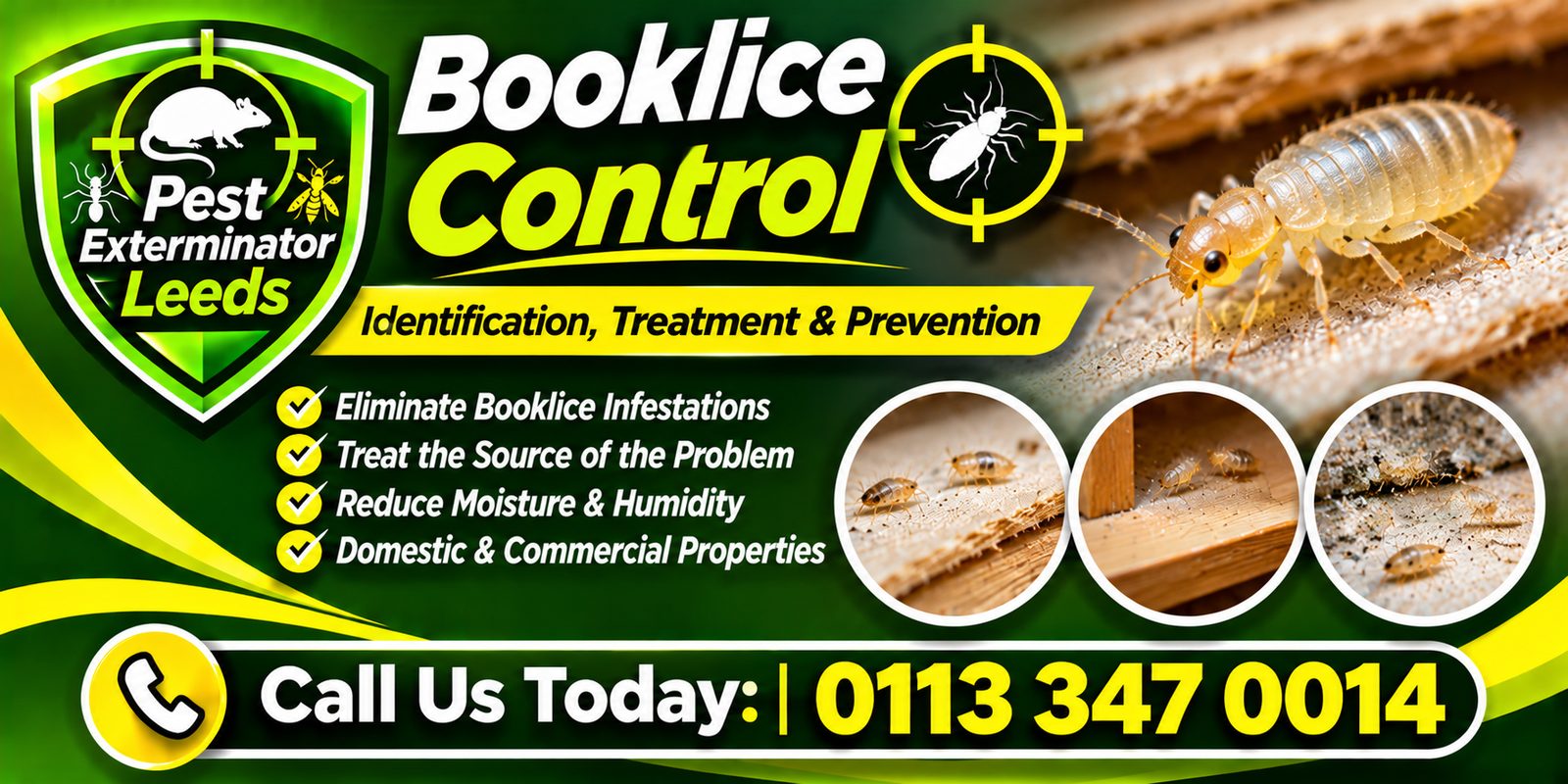
Tiny pale insects in cupboards, on window sills or among old paperwork usually point to damp. We find the moisture source, treat the infestation and explain how to stop it returning.
Booklice are very small, soft-bodied insects, often no bigger than a grain of salt and pale grey, cream or brown. Despite the name they do not bite and they are not true lice. They feed on microscopic mould and fungi that grow wherever surfaces stay damp, which is why they turn up on stored food, cardboard, wallpaper paste and the backs of old books. They are most active in warm, humid spells and in rooms that are rarely aired, and a small group can multiply quickly because females lay many eggs in hidden corners.
Most calls come after a property has been closed up, newly plastered, flooded, or has a slow leak that nobody has traced. In Leeds and West Yorkshire, solid stone walls, cellars, extensions and older terraces can hold moisture for a long time, and booklice are often the first visible sign that a room is staying wetter than it should. Treating the room once the insects are visible is straightforward, but if the underlying moisture is ignored the numbers often return within a few weeks.
Spraying the insects alone rarely holds, because the damp that feeds them is still there. Our approach looks at the room first, deals with the infestation second, and gives you clear advice on ventilation and drying. We offer free surveys for homes and businesses, and our technicians are fully insured and trained. The result is a plan you can follow, rather than a repeat visit every few months for the same problem.
We inspect the affected rooms and confirm the insect is a booklouse rather than a mite, a young silverfish or a carpet beetle larva.
We look for the moisture source, such as a leak, penetrating damp, condensation or poor airflow.
We treat the infested surfaces and gaps with a targeted insecticide suited to the room and its use.
We advise what to throw away, clean down or dry out, including affected stored goods and cardboard.
We recommend follow-up checks once the area has dried, so you know the problem has really cleared.
Booklice do not bite and are not known to spread disease. They can spoil stored food, damage paper and bindings, and a large population shows that mould is growing nearby. Some people with mould allergies may react to the damp conditions rather than the insects themselves.
Wiping away the insects does not remove the damp or mould they feed on. If the humidity stays high, new eggs hatch and numbers recover. Finding and fixing the moisture source is usually the step that decides whether they stay gone.
Sometimes, if a damp patch dries out fully, numbers fall away. Where the cause is ongoing, such as a leak or condensation, they tend to persist. A survey can tell you whether the conditions are likely to keep supporting them.
It depends on the size of the property, how widespread the problem is and how many visits are needed, as well as whether damp work is required alongside. We can give you a free quote once we know what you are dealing with.

Most visits follow the same pattern, starting with the damp and finishing with a clear plan for the room.
Read the walk-through →Six guides, from identification to what it costs.
Booklice are tiny, pale and easy to miss until they appear in numbers. Here is how to recognise them and tell them apart from other small insects.
Read the advice →Booklice rely on damp, so sprays on their own seldom solve the problem. This guide shows what to do first and when treatment adds value.
Read the advice →Booklice treatment is priced according to the property and the cause. This page explains what affects a quote and why a survey comes first.
Read the advice →Booklice are harmless to people but they point to a damp problem. Here are the signs, what they can spoil and why they are worth taking seriously.
Read the advice →Booklice need damp and mould to survive, so prevention comes down to humidity. These steps help to keep your rooms uninviting.
Read the advice →Many booklice problems can be handled at home, but not all. This guide explains where DIY helps, where it stops and what to look for in a contractor.
Read the advice →Choose your town for local information.
Fantastic service. Great communication and immediate response.Alison14 September 2020
Thanks to everyone involved from initial phone call to job completion. Prompt service, polite and job completed within 1/2 hour. Would definitely use you again if ever needed. Thanks once again Bev GreenwoodBev Greenwood11 September 2018
Prompt,pleasant and knowledgeable staff member carried out the removal of 3 wasp infestation in 3 adjoining properties. He explained every step of the process. Very good value compaired to other quotes. JanetJanet Walsh11 September 2018
Tell us what you have seen and where, and we will come back to you. There are no call-out charges and surveys are free for homes and businesses.